Every house trades indoor air for outdoor air, whether anyone plans it or not. In an older brick ranch, much of that exchange happens through gaps: around windows, at the sill plate, through attic penetrations and up a chimney. The house is drafty, but odors from frying, a damp towel pile or a full trash can get diluted and pushed outdoors fairly quickly.
A newer or renovated home may have tighter windows, sealed penetrations, and insulation that reduce uncontrolled air leakage. That can support comfort, but it also means indoor air needs a working intentional ventilation path. Odors that might have diluted in a draftier building can remain noticeable when exhaust fans are off, a ventilation controller is unfamiliar, or outdoor air is not being exchanged as expected.
The result can be a pattern that surprises residents: a home that feels stuffy, holds cooking odor, or develops a stale note during a season when windows stay shut. Those clues do not establish a structural defect. They suggest checking whether fans exhaust outdoors, whether a ventilation system is operating as intended, and whether a material is retaining the smell.
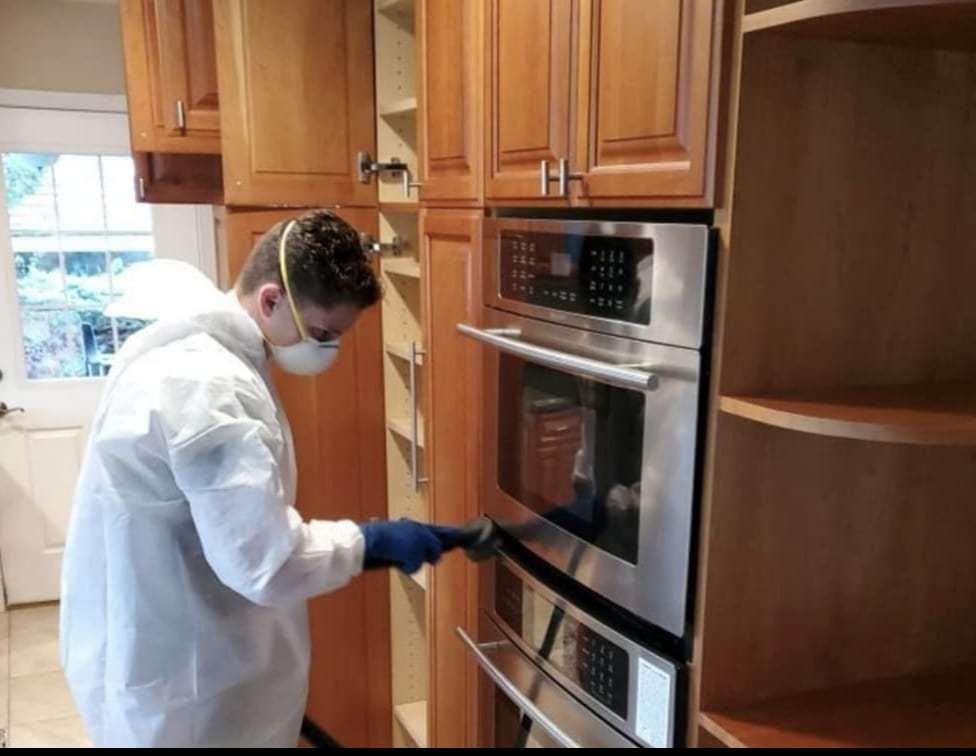
Technician in a protective suit cleaning the inside of a kitchen wall oven. Example of the work involved; the photo does not show a specific property or a job for this site.
Leaky older house versus tight newer house
Older, leakier house
- Odors dilute through constant small drafts
- Smells more likely to come from hidden places: crawl spaces, old ducts, wall cavities
- Humidity drops fast in winter, which keeps mustiness down upstairs
- Bath fans may be missing or vented into the attic
Tight, newer house
- Odors from daily living build up and linger
- Smells more often come from occupants, cooking, storage and new materials
- Indoor humidity from showers and cooking stays higher
- Ventilation depends on fans or a fresh-air system actually being used
Checks for a tight house that holds odor
- Go outside while the range hood runs and confirm air is coming out of an exterior cap, not just blowing back into the kitchen
- Do the same for each bathroom fan; a tissue held to the grille should be pulled in firmly
- Find out whether the house has a fresh-air intake, an ERV or HRV, or a ventilation timer on the furnace, and whether it is switched on
- Run bath fans for twenty minutes after showers, not just during them
- Change the furnace filter on schedule; a clogged filter reduces airflow and mixing
- Look for a closed-off room or closed supply registers, which leave stagnant pockets
- Notice whether the smell fades after a few hours with windows open; if it does, ventilation is the main issue
Common questions
Is a tight house unhealthy?
Not inherently. Tight construction works well when ventilation is designed in and used. Problems arise when fans are undersized, recirculate instead of exhausting, or are rarely switched on.
Will opening windows in winter waste a lot of energy?
Short, wide openings for ten or fifteen minutes exchange a lot of air without cooling walls and furniture much. A properly set ventilation system is the steadier option.
General information for Lowry, not a quote or professional advice. In an emergency, call 911.