Record a fan-on comparison
- Note the odor at the grille before switching the fan on and after it has run briefly.
- Check whether a shower, sink, toilet, or laundry fixture was recently used nearby.
- Inspect only the visible grille and accessible surfaces allowed by the equipment instructions.
- Look for a visible exterior vent cap from ground level, without climbing or removing covers.
- Record noise, vibration, condensation, staining, or odor that coincides with wind.
- Stop if there is heat, sparking, water near wiring, or a burning-plastic smell.
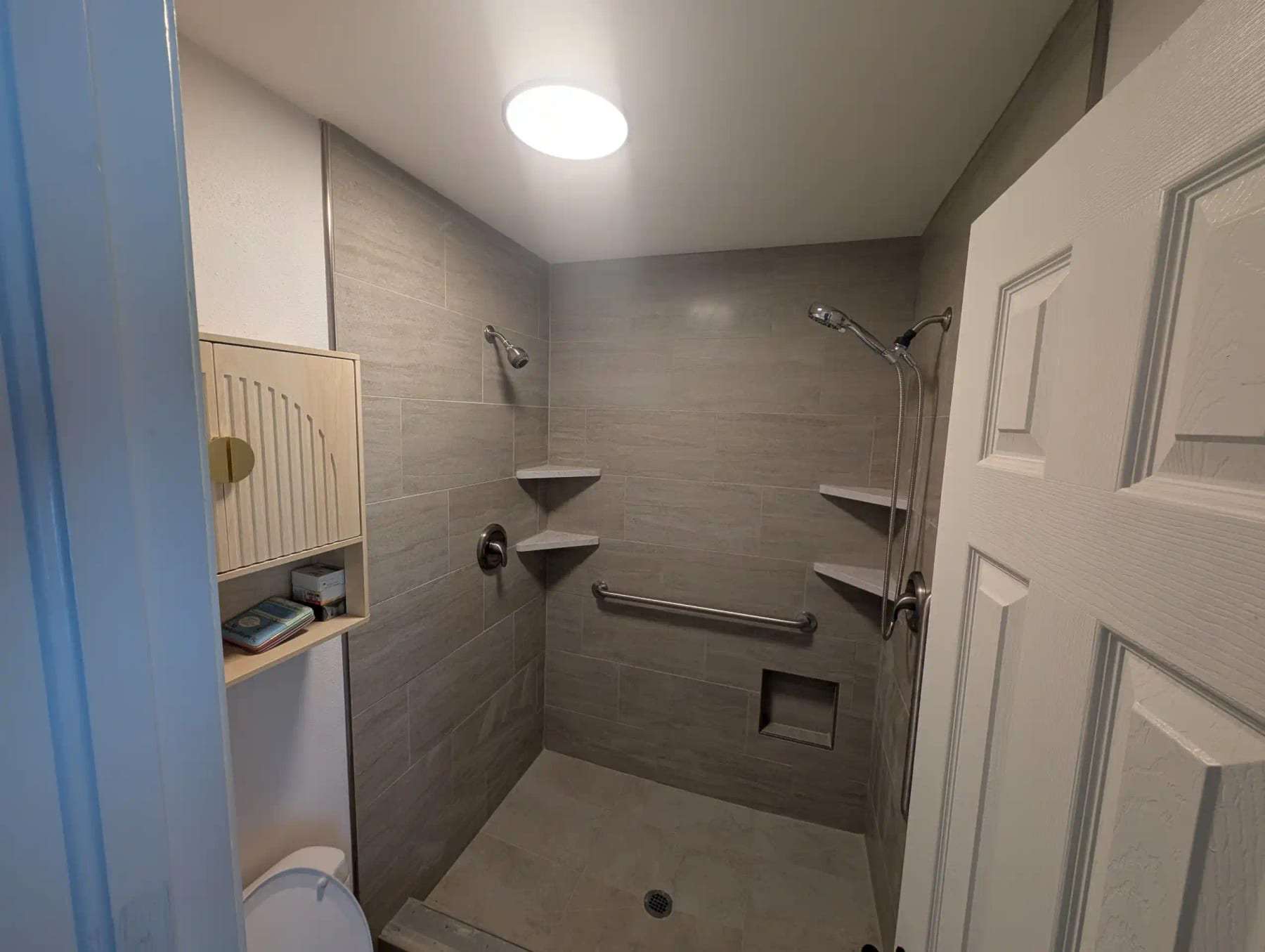
Finished tiled shower with built-in niches and a grab bar. A representative photo of the task, not a record of work at any particular property.
Observe the fan without dismantling it
A bathroom fan should move air toward its exhaust path, but a tissue test only indicates some airflow at the grille; it does not prove that the duct reaches outdoors or that the fan meets a design target. Dust on a grille can hold ordinary room odor. A damp duct, stuck backdraft damper, shared exhaust path, or nearby outdoor source may produce a different pattern. Do not push tools or sprays deep into the duct.
Compare conditions with the fan off, then on, and after a shower only if there is no electrical or burning warning. Notice whether the odor appears immediately, grows over time, or returns when the fan is switched off. Check the outside termination from a safe ground-level location if visible. A blocked or hidden termination, a duct that ends in an attic, or a flap that sticks requires proper inspection; reaching a roof or opening electrical equipment is not a routine homeowner test.
Clean only the grille and fan parts described as user-serviceable in the manual, after turning off power as instructed. If the fan is noisy, hot, visibly wet, or smells electrical, stop using it and arrange qualified review. When the odor resembles sewer gas, check nearby drains and plumbing clues as well; an exhaust grille can be where odor is noticed without being the source.
What timing can tell you
- Timing
- Dusty smell only at startup
- Possible explanation
- Dust on fan or grille
- Next step
- Clean serviceable parts per manual
- Timing
- Odor appears while fan runs
- Possible explanation
- Duct path or incoming air may matter
- Next step
- Document location and seek inspection
- Timing
- Odor strongest with fan off
- Possible explanation
- A drain or room source may be nearby
- Next step
- Compare fixture and room observations
- Timing
- Odor changes with wind
- Possible explanation
- A damper or pressure effect is possible
- Next step
- Record weather and avoid roof access
Common questions
Does a tissue test prove the fan works correctly?
No. It shows some air movement at that moment but not duct routing, flow volume, or safe termination.
Can a bathroom fan share a duct?
Some systems have shared components, while others do not. Check the installed design and avoid assuming a routing based on the grille alone.
General information for Lowry, not a quote or professional advice. In an emergency, call 911.